
To see this article in English, [click here].
한국어로 보시려면 [여기] 를 클릭해 주세요
日本語で読むには [こちら] をクリックしてください。
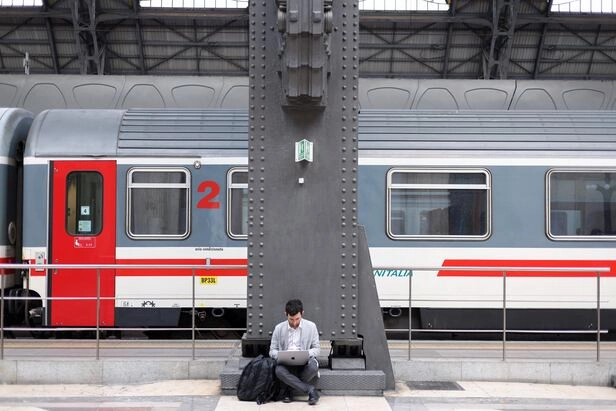
한 남성이 이탈리아 밀라노 중앙역에서 개인 노트북으로 작업하고 있는 모습. /로이터통신
CNN has turned its attention to the 'Digital Nomad Visa,' a new type of work visa introduced this year as a potential solution to South Korea's population crisis caused by its low birth rate. This visa allows remote workers to stay for up to two years, enabling them to work remotely and vacation within Korea.
On the 22nd (local time), CNN stated, "South Korea’s digital nomad visa is about more than just travel," adding that "some experts believe it could be a viable way to increase the workforce in a country with an incredibly low birth rate." The South Korean Ministry of Justice has been piloting the so-called 'Digital Nomad' (Workcation) visa since January 1st of this year to attract high-income personnel from overseas companies who work remotely while traveling the world.
Employment or profit-making activities within Korea are restricted, and a separate work visa is required for local employment. The period of stay is one year from the date of entry and can be extended for up to two years.
CNN assesses that this work visa is seen as a significant step in opening Korea to international workers. Seo Jung-ho, a professor at the George Washington University Institute for Korean Studies, said, "The work visa could be part of a larger plan to bring more foreigners to Korea," adding, "By implementing this new visa policy, the government is likely trying to lead an agenda or discussion to normalize social mixing between ethnic Koreans and non-Koreans."
Statistics Korea forecasts that Korea's fertility rate will drop from 0.78 in 2022 to 0.65 in 2025. Unlike Hong Kong, Thailand, or Bali in Indonesia, which have many foreign residents, Korea is characterized by a significantly homogeneous population. According to a survey on 'Racial Discrimination in Korean Society' released by the National Human Rights Commission of Korea in March 2020, 7 out of 10 immigrants responded that racial discrimination exists in Korean society.
Cho Jeong-hyun, founder of 'Digital Nomads Korea,' a community for foreign digital nomads staying long-term while working remotely in Korea, revealed that in a survey of 1,300 members, 83% of respondents expressed interest in the digital nomad visa.
However, there are opinions that the eligibility requirements are excessively high. Visa applicants must earn an annual income of at least 85 million KRW from a foreign company, provide proof of private medical insurance, and have a clean criminal record. In a survey by 'InterNations,' an internet portal used by foreigners living abroad, Korea ranked low at 50th out of 53 countries in the 'Best Countries for Expats' category.
'Digital Nomad World,' a website analyzing remote worker trends, estimated that foreigners coming to work in Korea would spend an average of $2,050 (approx. 2.7 million KRW) per month to live in Seoul. This cost includes housing, food, public transportation, and co-working spaces.
Source: